 ultimate-guide
Is Termite Protection Worth It for Old Homes?
Table of Contents
- Is Termite Protection Worth It for Old Homes?
- Why Old Homes Face Higher Termite Risk
- Signs of Termite Damage in Old Houses
- How Often Should an Old House Be Inspected for Termites?
- Termite Inspection Cost: What You Are Actually Paying For
- Treatment Options Compared for Occupied Older Homes
- A Decision Framework for Existing Damage
- Preventive Maintenance for Older Properties
- Frequently Asked Questions
Last Updated: October 9, 2026
Is Termite Protection Worth It for Old Homes?
For most older homes, termite protection is worth it.
Termite protection combines barriers, treatments and ongoing inspections that stop subterranean termites reaching your home's timber. It is a maintained system, not a one-off purchase.
Old homes change the maths. A 1950s weatherboard cottage on brick piers has more timber-to-soil contact points, more subfloor access, and often a barrier installed decades ago that has since broken down, making protection more important and the method choice more specific.
Why Old Homes Face Higher Termite Risk
Older homes face higher termite risk because of how they were built, not just how long they have stood. Mid-century construction used timber stumps, untreated framing, and minimal soil-to-floorboard clearance, exactly what termite colonies look for.
Construction Details That Leave Gaps
Three features show up again and again in older properties:
- Timber stumps and bearers sitting close to or in contact with soil, giving termites a direct path into the structure
- Poor subfloor ventilation, which traps moisture and softens timber over time
- Additions and renovations that broke the original barrier line, leaving untreated gaps around new slabs or decking
A common mistake is assuming an old barrier still works. Chemical treatments degrade, and physical barriers get disturbed by landscaping, plumbing and drainage work. Without a current inspection report, nobody knows what is protecting the house.

The Cost of Doing Nothing
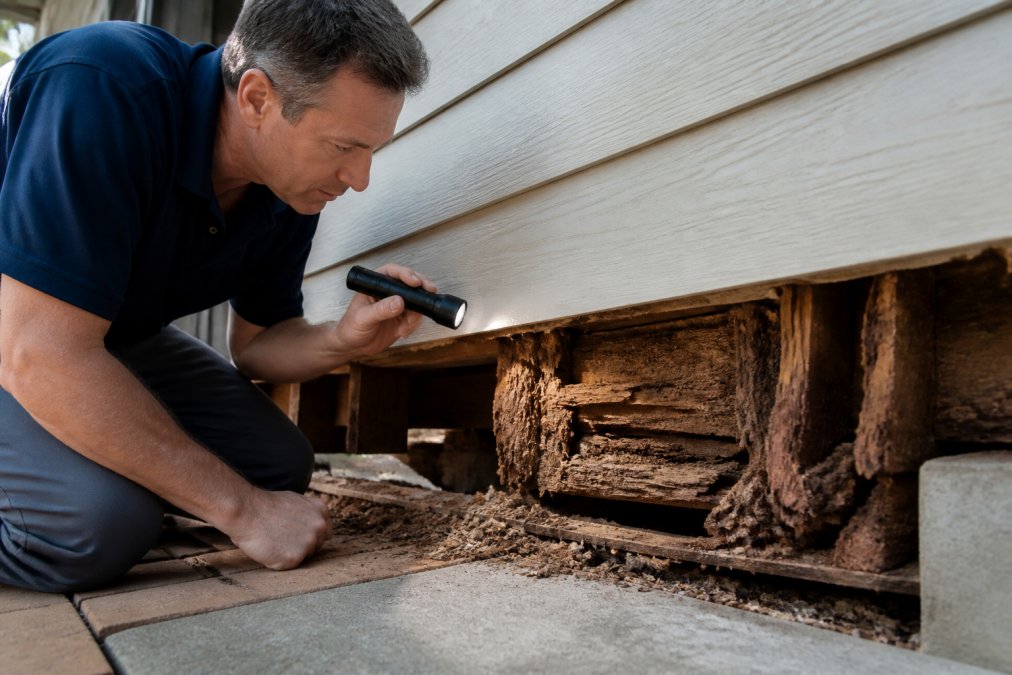
Termite damage is rarely dramatic at first, a soft skirting board, a hollow floorboard, or a paint blister that keeps returning. By the time damage is visible, the colony has usually been feeding for months.
Repair costs scale with the damage and are not covered by standard home insurance. That is the core of the cost-benefit argument: you are paying to avoid an uninsured structural repair, not to avoid termites entirely.
Signs of Termite Damage in Old Houses
Signs of termite damage in old houses include hollow-sounding timber, mud tubes on foundations or stumps, bubbling or blistered paint, and springy floors. In older homes these are easy to miss because some look like normal ageing.
Look for:
- Mud tubes running up stumps, piers or foundation walls
- Timber that sounds hollow when tapped
- Doors and windows that suddenly stick, because termites have warped the frame
If you find any of these, do not disturb the area. Termites retreat when exposed, making them harder to locate. Book an inspection and let a technician trace the activity properly.
How Often Should an Old House Be Inspected for Termites?
An old house should be inspected for termites at least once a year, and more often if it has had previous activity, sits in a high-risk area, or has had recent landscaping or renovation work.
For properties with a history of termites, a six-monthly schedule is common: a treatment warranty usually depends on inspections being kept up to date.
A proper inspection covers the subfloor, roof void, interior, exterior, fences, trees and retaining walls, and ends with a written report noting activity, damage, conducive conditions and recommendations.
Termite Inspection Cost: What You Are Actually Paying For
Termite inspection cost depends on the size, age and accessibility of the property. What matters more than a single figure is what drives the price, and how the fee compares with the repair bill it prevents.
What Drives the Price
Four factors move an inspection quote most:
- Accessibility. A home on brick piers with a clear subfloor is faster to inspect than a low-set home with a 300 mm crawl space, packed soil and limited entry. Older homes often fall into the second category, so their inspections cost more than a modern slab-on-ground property.
- Size and complexity. Extensions, multiple roof voids, detached garages, decks and retaining walls add inspection time. A 1950s cottage with a 1990s rear extension has two building envelopes to check.
- Roof void access. Some older roofs have no manhole, or one too small for safe entry. If the roof void cannot be inspected, the report must say so, and that limits what the inspection can guarantee.
What a Fair Inspection Fee Buys
A properly priced inspection covers:
- A full physical check of the subfloor, roof void, interior, exterior, fences, trees and retaining walls
- Moisture and conducive-condition assessment
- Termite activity and damage identification, including past activity
What most quotes miss is that a cheap inspection and a cheap treatment are not the same product. A quick walk-around with no report gives you nothing to act on and no baseline for next year. Ask what the report includes before comparing prices.
The Cost-Benefit Comparison That Actually Matters
Here is the comparison most homeowners never run. An annual inspection is a recurring, predictable expense. A structural termite repair is unpredictable and uninsured, typically involving a carpenter, possibly a structural engineer, replacement of damaged bearers or floor joists, and sometimes a building permit.
That asymmetry is the whole argument. You are comparing a known annual fee with an unknown repair bill standard home insurance will not cover.
When the Maths Changes
In some cases the cost-benefit case is weaker or needs a different approach:
- Homes with no accessible subfloor and no roof void access. If large parts of the structure cannot be inspected, the value of a standard inspection drops. Ask what alternative methods (moisture meters, thermal imaging, borescopes) the provider uses.
- Homes already scheduled for demolition or major renovation. If the structure is coming down within a year, a full barrier installation may not be worth it. A targeted inspection and colony treatment may be the better spend.
- Homes in a known low-risk area with a recent, well-documented barrier. The inspection is still worth doing, but the case for upgrading to a more expensive treatment may not be there.
For current pricing on inspections and treatments, contact Challenge Pest Control for a free quote and free advice. We offer pensioner discounts and provide fully insured, guaranteed work.
Treatment Options Compared for Occupied Older Homes
Treatment options for occupied older homes fall into three categories: chemical soil barriers, baiting and monitoring systems, and physical or combined approaches. The right choice depends on whether you are preventing termites or managing active ones, how much disruption the household can tolerate, and how accessible the perimeter and subfloor are.
| Method | Best For | Disruption | Access Needed | Ongoing Requirement |
|---|---|---|---|---|
| Chemical soil barrier | Prevention on accessible perimeters | Moderate, limited drilling | Perimeter and subfloor access | Annual inspections |
| Baiting system | Active colonies, sensitive households, tight access | Low, in-ground stations | Yard space for stations | Regular monitoring |
| Physical barrier | New work and renovations only | High during installation | Construction-stage access | Annual inspections |
| Combined approach | Older homes with active activity | Varies by site | Varies | Annual inspections |
Chemical Soil Barriers
A chemical soil barrier creates a treated zone in the soil around and under the home that termites cannot cross undetected. It suits older homes with an accessible perimeter where you want broad protection rather than colony-specific treatment.
The limitation is access. If a concrete path or paved courtyard runs along the house, the technician must drill through it to reach the soil, standard practice, but worth knowing beforehand.
Baiting and Monitoring Systems
Baiting systems place in-ground stations around the property and use termites to carry slow-acting bait back to the colony. They are the least disruptive option for an occupied home, often chosen for older properties with active activity and tight access.
The trade-off is time. Baiting works on the colony's schedule, not yours, and needs ongoing monitoring. If a station is disturbed by pets, landscaping or mowing, effectiveness drops.
Physical and Combined Approaches
Physical barriers are installed during construction or major renovation, so they are rarely a retrofit option. For older homes with existing damage, a combined approach usually makes the most sense: treat the active colony, then install a barrier or baiting system to prevent re-entry.
Choosing When You Cannot Vacate
Most older homes are occupied during treatment, which rules some options in and others out. Chemical soil barriers can usually be installed with the household in place, but drilling through paths and paving creates noise and dust, and treated zones must be kept clear of disturbance afterwards. Baiting is least disruptive but slowest to show results. Physical barriers are off the table unless you are already renovating.
A practical decision sequence for an occupied older home:
- Confirm whether there is active activity. Prevention and colony elimination are different jobs.
- Map the access. Which perimeters can be treated, which subfloor areas can be reached, and which cannot.
- Match the method to the access and the household. A baiting system may be the only viable option where a barrier cannot be installed completely.
- Agree the monitoring schedule in writing. This is what keeps the treatment warranty valid.
A Decision Framework for Existing Damage
Existing damage does not mean the house is a lost cause. It means you need a sequence, not a single product.
Work through it in this order:
- Get an independent inspection to establish the extent of activity and damage. A written report is essential.
- Treat the active colony first. Barrier or bait, whichever suits the site. Prevention before colony elimination does nothing.
- Repair structurally compromised timber once activity has stopped, not before.
- Install ongoing protection so the repaired areas are not reinfested.
- Set a monitoring schedule and keep it. This is what protects your treatment warranty.
The mistake we see most often is skipping step one and going straight to a treatment quote. Without a report, you cannot tell whether the treatment worked or the damage was fully addressed.
Preventive Maintenance for Older Properties
Preventive maintenance for older properties means removing what termites need: moisture, timber-to-soil contact, and undisturbed access. None of it is expensive, and all of it extends the life of your treatment.
- Fix leaking taps, downpipes and gutters promptly
- Keep subfloor vents clear and unobstructed
- Store firewood and timber off the ground and away from the house
Moisture control is the highest-value item on that list. Damp subfloors attract termites and hide activity, and are the most common conducive condition we find in older homes.
Frequently Asked Questions
What is the best preventative for termites in older homes?
A combination of regular inspections, moisture control, and a chemical or baiting system works best for older homes. Reducing timber-to-soil contact and fixing drainage issues removes the conditions termites need. Chemical soil treatments create a treated zone around the foundation, while bait stations monitor and eliminate active colonies. Because older homes often lack modern barriers, a layered approach gives the most reliable termite protection.
How long does a physical termite barrier last in an existing home?
Physical barriers installed during construction can last decades, but in existing homes they are rarely present or intact. Chemical barriers typically last five to eight years depending on the product and soil conditions. Baiting systems require ongoing monitoring and replenishment. Barrier breakdown is common in older properties where soil movement or renovations have disturbed the original protection.
Do older homes have a higher risk of termite infestation?
Yes. Older homes often have timber-to-soil contact, poor drainage, and original construction methods that left gaps in protection. Renovations and extensions can also create hidden entry points. The combination of aged timber, moisture, and missing barriers makes regular inspections and preventive treatment more important than for newer builds.
Is a termite inspection enough, or do I need a full barrier?
An inspection only detects activity; it does not stop termites. If the inspection report shows no activity but your home has risk factors like timber-to-soil contact or previous damage, a barrier or baiting system adds ongoing protection. For homes with active termites, treatment is essential. Inspections and barriers work together: the inspection monitors, the barrier prevents.
Older homes ask more of their owners, and termite protection is one of the few maintenance items where the cost of skipping it lands entirely on you. Challenge Pest Control has protected properties across the metropolitan area since 1987, with fully insured, guaranteed work, 24/7 availability, free quotes and free advice, and pensioner discounts. Call 0422 926 291 and book an inspection today.